

Assisi and Spoleto: The Sacred and the Festive
Two Umbrian cities sixty kilometres apart offer, between them, the complete range of what this region does best: sacred art of the first order, one of Europe's great performing arts festivals, extraordinary food and a landscape of sustained beauty.
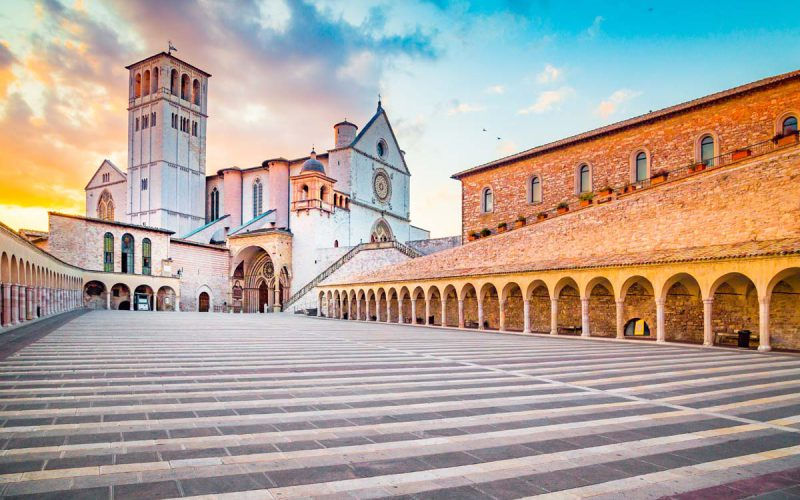
Assisi is one of those places whose reputation is so large and so long-established that the reality of a first visit is expected to disappoint. It does not disappoint. The Basilica di San Francesco, seen for the first time from the road below at the right hour — the late afternoon light on the two superimposed churches, the bell tower above, the plain of Santa Maria degli Angeli extending to the distant Apennines — is as beautiful and as grave as any building in Italy. The art inside — Cimabue's painted cross in the Lower Basilica, Giotto's cycle of the Life of St Francis in the Upper — is of the first importance in the history of Western painting. And the figure in whose honour all of this was built remains, eight centuries later, one of the most consequential human beings in the history of Italian Christianity. We approach Assisi with the seriousness these facts require.
The key to Assisi is timing. At dawn, before the first pilgrimage groups have arrived from the Portiuncula below the city, the Upper Basilica is a space of extraordinary concentrated beauty — the Giotto frescoes visible in the first slanting light through the Gothic windows, the space entirely quiet. The cycle, comprising twenty-eight scenes of the life of Francis arranged in two registers around the nave, was painted between approximately 1297 and 1300 and established the model for narrative fresco painting that Italian artists would follow for the next century and a half. The spatial intelligence of the compositions — each scene occupying a consistent pictorial depth, the figures arranged within recognisable architectural and landscape settings that create the illusion of actual space — constitutes the founding document of illusionistic painting in the Western tradition. We spend an hour in this room, before any other visitor, with a guide whose specialty is the Franciscan iconographic tradition. The hour justifies the entire journey to Umbria.
Assisi Beyond the Basilica: Francis's Own Landscape
The most powerful Franciscan experience outside the Basilica is the Eremo delle Carceri: the small hermitage carved into the forested flank of Monte Subasio, above the city, accessible by a forty-minute walk through oak and holm oak forest, where Francis retreated for extended periods of prayer in caves whose smallness and austerity make his spiritual ambition immediately and physically legible. The combination of the physical effort of the ascent, the beauty of the Subasio forest, the view back over the Umbrian plain from the highest point of the path and the intimate scale of the hermitage itself produces an understanding of the Franciscan project — the deliberate embrace of poverty and solitude as a spiritual method — that no amount of museum-going can substitute for. We include the Eremo walk in every Assisi programme designed for guests with a serious interest in the historical and spiritual context of Giotto's paintings.
Spoleto: The Festival City and Its Ancient Theatre
Spoleto — a compact, layered city of great visual and historical variety — is primarily known internationally for the Festival dei Due Mondi, the performing arts festival founded by Gian Carlo Menotti in 1958 that transforms its historic spaces into stages of exceptional quality for three weeks in late June and early July. The Roman theatre, whose scaena wall stands to near its original height and whose acoustics produce a natural reverb of considerable beauty, hosts open-air performances under conditions of atmospheric drama that no modern venue can replicate. The Piazza del Duomo — with Filippo Lippi's apse frescoes visible through the cathedral's open west door and the surrounding medieval palaces forming a standing-room auditorium of considerable elegance — hosts the most celebrated concerts of the festival season. We secure the finest reserved seats, arrange accommodation in the best hotels during the festival period and design the surrounding cultural programme — the Roman theatre, the Ponte delle Torri, the Pinacoteca Comunale with its Filippino Lippi — with the depth and access that the standard festival visitor experience does not provide.
Norcia, the Valnerina and the Black Truffle
East of Spoleto, the Nera River descends through the Valnerina gorge — one of the most scenically dramatic landscapes in Umbria — to reach, after an hour's drive, the Piano Grande di Castelluccio and the highland plateau beyond. Norcia, at the head of the valley, is the birthplace of St Benedict and the undisputed capital of central Italian black truffle production: the Tuber melanosporum from the oak and hornbeam woods around the town is harvested between December and March in quantities sufficient to support a daily market whose quality and variety make it one of the finest in Italy. We arrange private truffle hunts in the Norcia hills with an experienced trifolau and his dog, followed by a lunch at one of the excellent local trattorie whose menus are designed entirely around the morning's finds, as the ideal extension of a Spoleto cultural programme into the culinary landscape of eastern Umbria.
The Upper Basilica at dawn, before the pilgrims arrive, with Giotto's frescoes catching the first light through the Gothic windows — this is not the standard way of visiting Assisi. But it is the way that produces an understanding the standard way cannot.
The Essentials
Best season: April–June for the Assisi landscape; late June–July for the Spoleto Festival
Signature experience: Pre-dawn Upper Basilica with a specialist in Franciscan iconography; Festival dei Due Mondi private seats
Stay: Historic centre hotels in Assisi or Spoleto; converted Umbrian farmhouses in the surrounding hills
Combine with: Perugia (20 min), Norcia and the Valnerina, Montefalco for Sagrantino
Every journey we design is entirely bespoke — crafted around your preferences,your pace, and your desire for the exceptional.


