

Parma: The City That Eats Better Than Anyone
The region that invented the concept of cucina ricca invites a particular kind of travel: early mornings, working kitchens, the people who know. Parma is not a city that needs to explain itself to anyone who has tasted its products properly. We arrange the conditions for that tasting.
There is a category of food travel that is not about restaurants. It is about the processes that make the ingredients — about standing in a curing room at dawn watching the light come through the shuttered windows onto ten thousand hanging hams, or watching a cheesemaker break the curd in a copper cauldron with a wire whisk the size of a broom, or opening the door of a riverside cantina in February and understanding, immediately and physically, why the fog matters. Parma is the centre of this kind of travel in Italy. Possibly in the world.
The city itself rewards time independent of its gastronomic programme. The Baptistery — an octagonal structure in pink Verona marble whose carved reliefs by Benedetto Antelami are among the summits of Italian Romanesque sculpture — and the Camera di San Paolo, frescoed by Correggio around 1519 in a programme of mythological allegory of extraordinary visual intelligence, are each deserving of a private morning visit with an art historian of the right calibre.
The Teatro Regio — whose demanding audience has maintained the reputation of being the most unforgiving opera public in Italy since the house opened in 1829 — provides an evening programme during the season. But the great work of a Parma visit is conducted, properly, before the city wakes up.
Prosciutto di Parma: Mountain Air and Long Time
The Langhirano valley south of Parma and its neighbouring hills constitute the only legally defined zone in the world where Prosciutto di Parma DOP can be produced — because only here does the specific mountain air that flows through the Apennine passes from the Ligurian coast provide the dry, aromatic curing environment that eighteen months of hanging in properly shuttered galleries requires.
We arrange private visits to a historic prosciuttificio — a curing house of the old school, where the process has not been significantly mechanised and where the maestro salatore's knowledge of the precise state of each ham in the gallery is the product of decades of practice — for a tour of the full production cycle followed by a private tasting: a leg pulled and sliced by hand to translucent thinness, with aged Parmigiano and a glass of local Malvasia frizzante.
The flavour of properly made Prosciutto di Parma, eaten at the point of production, has no commercial equivalent.
Parmigiano Reggiano: A Four-Thirty Appointment
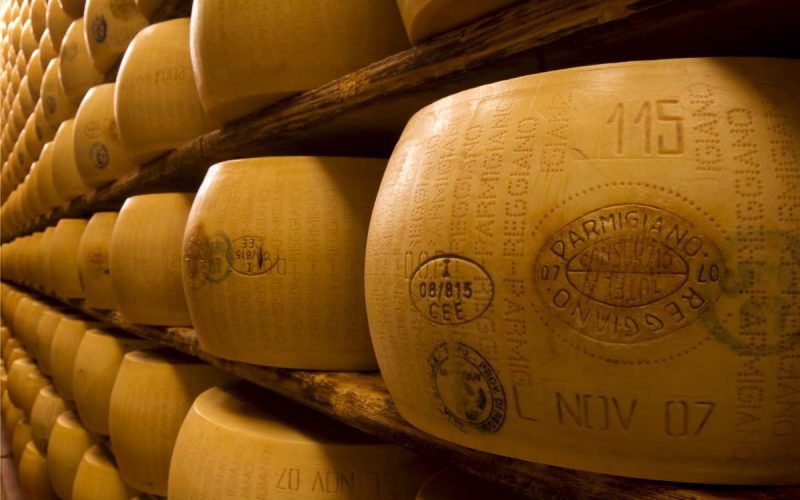
The Benedictine monks who codified the production of Parmigiano Reggiano in the Po Valley dairies of the twelfth century established a procedure that eight hundred years of subsequent development has not improved upon. The double-cream evening milk meeting the fresh morning milk in the copper cauldron, the curd breaking and granulating over heat, the twin forms rising in their linen cloths, the long bath in saturated brine: each step is the accumulated wisdom of a tradition that predates industrial food production by six centuries and continues to outperform it.
We arrange visits to one of the finest cooperative dairies in the DOP zone, beginning at four-thirty in the morning when the day's production starts, and ending with a comparative tasting across multiple ages: fresh cheese at twelve months, granular and developing at twenty-four, fully formed and complex at thirty-six.
Culatello di Zibello: The Fog, the River and the Rarest Salume
The floodplain of the Po south of Parma — flat, fertile, shrouded in river fog from November through March — is the production zone for Culatello di Zibello DOP, the cured meat that the finest Italian chefs describe, consistently, as the most complex and the most sublime of the category. The culatello is the inner thigh muscle of the pig, cured, wrapped in the animal's own bladder and hung in riverside cantine where the specific humidity and the particular mould spores carried in the Po fog do, over a minimum of twelve months and often more than twenty, what no controlled environment can replicate.
The families who have been making culatello on the same properties in Zibello, Polesine Parmense and Busseto for generations do not operate public tours. We have built the personal relationships that make private visits possible — and the experience of opening the cantina door, seeing the rows of hams in their various stages of transformation and tasting a slice of culatello at peak maturity in the place where it was made, is one of the most specific and least replaceable pleasures of Italian food travel.
Culatello di Zibello in its prime is not merely cured meat. It is the concentrated essence of a place — the Po fog, the river air, the families who have understood this process for twenty months at a time — arrived, finally, at your plate.
The Essentials
Best season: October–April for fog and culatello culture; year-round for prosciutto and Parmigiano
Signature experience: Culatello cantina visit with a founding producer family in the Zibello zone
Stay: Parma historic-centre hotels; or a converted farmhouse in the Po plain
Combine with: Modena (balsamic, Osteria Francescana), Bologna, Motor Valley
Every journey we design is entirely bespoke — crafted around your preferences,your pace, and your desire for the exceptional.


