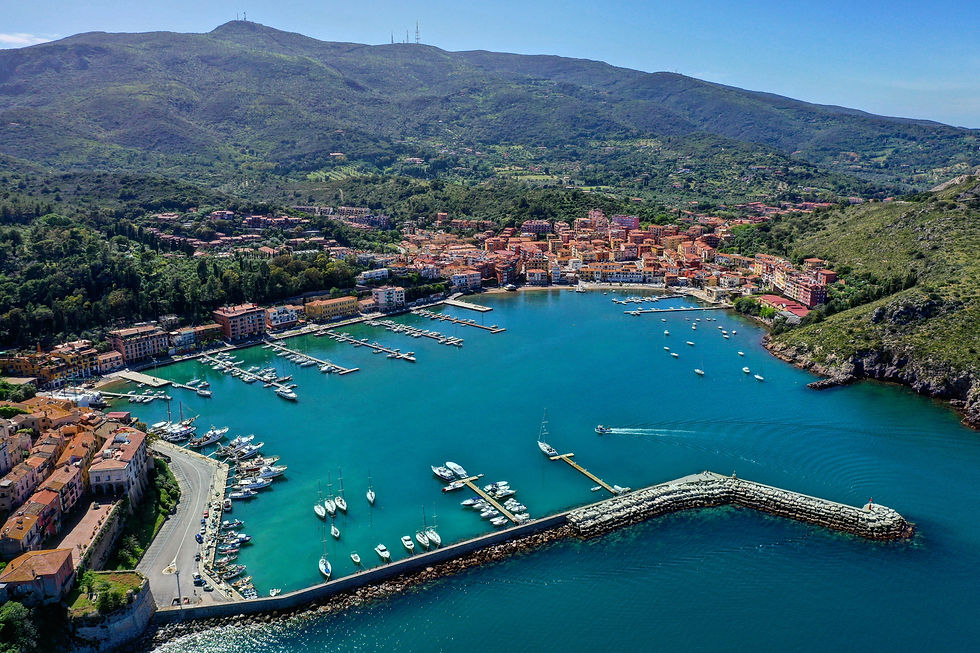
The Aeolian Islands by Private Yacht
- 2 giorni fa
- Tempo di lettura: 4 min
Volcanoes, caper vineyards and silent coves — a week in the seven islands that sit, half-forgotten, between Sicily and the open Tyrrhenian.

There is a particular kind of anchorage one can take, in the late afternoon, in the small bay below the village of Pollara on the western flank of Salina, that is among the more memorable anchorages in the central Mediterranean. The cliff rises seven hundred metres above the sea on one side. The volcano of Filicudi smokes faintly to the west. The water is so clear that the boat appears to float in nothing at all, and the only sounds are the boat's generator running quietly and a distant goat bell from the cliffs above. To watch the sun set from this position, with a glass of the local Malvasia delle Lipari and a small dish of capers from the vineyard at Capofaro that is visible across the water, is to understand why a certain kind of traveller has been quietly visiting these islands for forty years and not telling anyone about it.
The Geography of the Archipelago
The Aeolian Islands are a chain of seven volcanic islands lying north of the Sicilian coast in the southern Tyrrhenian Sea. From east to west they are: Stromboli, with the active volcano that erupts every twenty minutes; Panarea, the smallest and most fashionable; Lipari, the largest and the administrative centre; Vulcano, with the sulphurous fumaroles and mud baths; Salina, the greenest and the most agricultural; Filicudi, smaller and quieter; and Alicudi, the most remote and least visited. Each has a distinct character. A week-long charter that touches all seven is a stretching plan but a workable one; a more relaxed week typically anchors at four or five.
We do not generally recommend basing a stay on land in the Aeolians. The hotels on Lipari, Panarea, and Salina are perfectly competent — Capofaro on Salina, with its cliffside restaurant and Malvasia vineyards, is a genuinely memorable property — but the islands ask to be experienced from water. The interisland ferries are slow and crowded in summer; the private yacht is not.
The Boats That Suit
The right boat for an Aeolian charter is smaller than the right boat for an Amalfi or a Sardinian charter. The harbours are small, the anchorages are intimate, and the appropriate scale is somewhere between thirty and forty metres. A larger vessel will struggle to find suitable moorings at the more atmospheric anchorages — the small bay below the lighthouse on Filicudi, for instance, which can hold three forty-metre boats but not three sixty-metre boats. We work with several charter offices in Naples and Palermo whose Aeolian inventory is, by some measure, the best.
The crew matters more here than almost anywhere in Italian yachting. The captain who knows the Aeolians well will have a relationship with the harbourmaster at Stromboli, with the family who runs the small restaurant at Panarea's Cala Junco, with the producer at Tenuta di Castellaro on Lipari who can arrange a private cellar visit on a day's notice. These relationships are not, in our experience, easily replicated by even an excellent captain who is making his first Aeolian charter.
A Week, Day by Day
We typically board at Milazzo on the Sicilian coast and propose the following sequence. Day one, the short crossing to Vulcano for the afternoon, with a swim at the Spiaggia delle Sabbie Nere (the volcanic black-sand beach) and a sulphur bath for those who want one. Day two, the passage to Lipari, with anchor at Marina Lunga and an afternoon shore excursion to the archaeological museum and the small old town. Day three, on to Panarea, anchoring at Cala Junco — among the most beautiful anchorages in the central Mediterranean — for the swim and the lunch on board. Dinner ashore at the Hotel Raya, which remains the great social institution of the Aeolians.
Day four, the passage east to Stromboli, timed to arrive in the late afternoon. The boat anchors off the Sciara del Fuoco, the lava chute on the northern flank, and the night is spent at anchor watching the volcano's eruptions illuminate the cliff face every fifteen or twenty minutes. Day five, the passage west to Salina for two nights of anchorage at Lingua and a shore visit to Capofaro for the Malvasia tasting and dinner. Day six, the longer passage west to Filicudi, with anchor at the Grotta del Bue Marino for an afternoon swim. Day seven, the return passage east to Lipari and onwards to Milazzo. A more relaxed plan substitutes a second day at Salina or at Stromboli for one of the western islands.
What These Days Are
An Aeolian week is, in our experience, the quietest week of yachting that the Italian summer offers. The islands are not glamorous in the sense that the Costa Smeralda or the Côte d'Azur are glamorous. There is no Phi Beach, no Yacht Club; the social pageant is replaced by the geological one. The anchorages are short of the headline boats. The shore meals are simple and devastatingly good. The volcano, every night, does what it has done for two thousand years.
The clients who return most often from these journeys describe them, almost uniformly, in terms of slowing down. The phone signal is variable. The schedule is loose. The boat moves when it moves. The week ends, somehow, having seemed both shorter than expected and longer than expected, which is a combination one rarely encounters elsewhere in modern travel. It is, for the right client, the most concentrated form of the Mediterranean experience left.