Umbria Uncovered
Norcia, Assisi and the beating heart of Italy — the case for Umbria in November, when the region is at its quietest and its most authentically itself.

There is a moment in early November in the upper Valnerina, the high valley that runs eastward from Norcia toward the Sibillini, when the chestnut forests above the town turn the particular bronze that the late Italian autumn produces and the smoke from the wood fires of the small villages drifts low across the valley floor. The visitor on the road from Spoleto to Norcia at this hour will pass three or four small towns of grey stone, each with a church and a piazza and a small bar where the regulars are sitting outside in heavy coats, and will, on most occasions, encounter no other visitor traffic at all. This is Umbria in November. It is, in our considered view, the finest week to visit the region.
The Quieter Italian Heart
Umbria is, by any reasonable measure, the most authentically rural of the central Italian regions. It has no coastline, no major international airport, and no city of more than a hundred and fifty thousand people. The population density is low; the agricultural tradition is deep; the small towns have, with a few exceptions, retained their genuine character to a degree that even Tuscany has, in some areas, lost. The result, for the visitor, is a region that feels — particularly in the off-season months — like the central Italy of an earlier generation.
We send our second-time and third-time central Italy clients to Umbria with confidence. The first-time client typically wants Florence, Siena, the Val d'Orcia; the experienced client, having done that journey, often returns to Italy looking for a deeper version. Umbria is that version. It is less photographed, less crowded, less developed at the high luxury end, and — in the months between October and April — almost completely empty of international visitors.
Norcia, After the Earthquake
Norcia, the small medieval town in the Valnerina that is the centre of the Italian high-end pork trade, was substantially damaged in the earthquake of 2016. The major civic buildings — the basilica of San Benedetto, the city walls, the smaller churches — have been the subject of a long and expensive restoration that, in 2026, is approximately seventy per cent complete. The town is fully open and functioning; the famous norcineria butchers, including the historic Ansuini and Coccia, are operating; the major hotels in the area, including the recently restored Palazzo Seneca, are receiving guests. The earthquake has, importantly, not broken the town's identity. The norcineria culture — the centuries-old tradition of pig-curing that has made Norcia synonymous with the highest level of Italian pork — is, if anything, more visible in the town now than before the earthquake.
We arrange visits to Norcia in November as the centrepiece of an Umbrian week.
The norcineria visits — to Coccia in particular, where the family will receive serious clients in the back rooms behind the shop — are among the more memorable food experiences in central Italy. A long lunch at Vespasia, the starred restaurant at Palazzo Seneca, is a serious culinary occasion. The sense of being in a town that has, against considerable adversity, kept itself together, is one that affects most visitors who pay attention.
Assisi and the Spiritual Geography
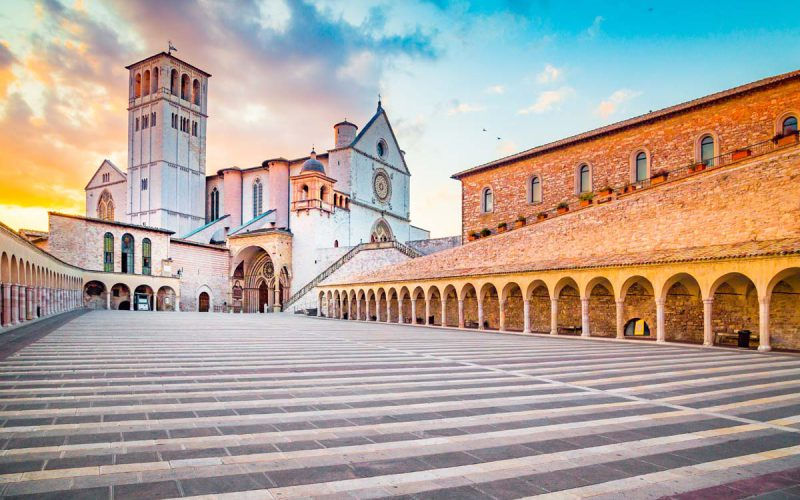
Assisi is the major site of any Umbrian itinerary and is best visited, in our view, in the off-season weeks when the religious tourism that fills the town in summer has thinned. November is precisely the right month. The Basilica of San Francesco — with the Giotto fresco cycle of the life of Saint Francis in the upper church and the earlier Cimabue work in the lower — is more or less empty by mid-November in the morning hours. We arrange private guided visits with art historians who specialise in the Franciscan iconography, and the visit, conducted in a near-empty basilica with an expert who can speak to the particular concerns of the patron, is one of the more rewarding visits in Italian art history.
We typically combine Assisi with a visit to Spello, ten minutes away, with its smaller but completely intact medieval centre and the Pinturicchio frescoes in the church of Santa Maria Maggiore. We sometimes add Bevagna, with its particularly well-preserved Roman amphitheatre. These small towns, in November, are essentially as they were when the central Italian Grand Tour passed through them in the nineteenth century.
Where to Stay
The Umbrian luxury hotel scene has matured considerably in the last decade. Our institutional answer is Castello di Reschio, the restored castle and surrounding estate near Lisciano Niccone in northern Umbria, which opened as a hotel in 2021 and is now, by any reasonable measure, the finest hotel in the region. The thirty-six rooms occupy the castle and the surrounding agricultural buildings; the kitchen is excellent; the property's grounds extend to nearly fifteen hundred hectares. For our most demanding clients, this is the recommended base.
Borgo dei Conti, near Perugia, is the smaller and more contemporary alternative. The Palazzo Seneca in Norcia is the obvious choice for clients who want to be in the Valnerina specifically.
For clients who want a more independent stay, we curate a small inventory of restored country houses — typically the ancestral homes of Umbrian families, taken with full domestic staff and a private chef — that are not on any rental site and that come to us through long-standing relationships.